
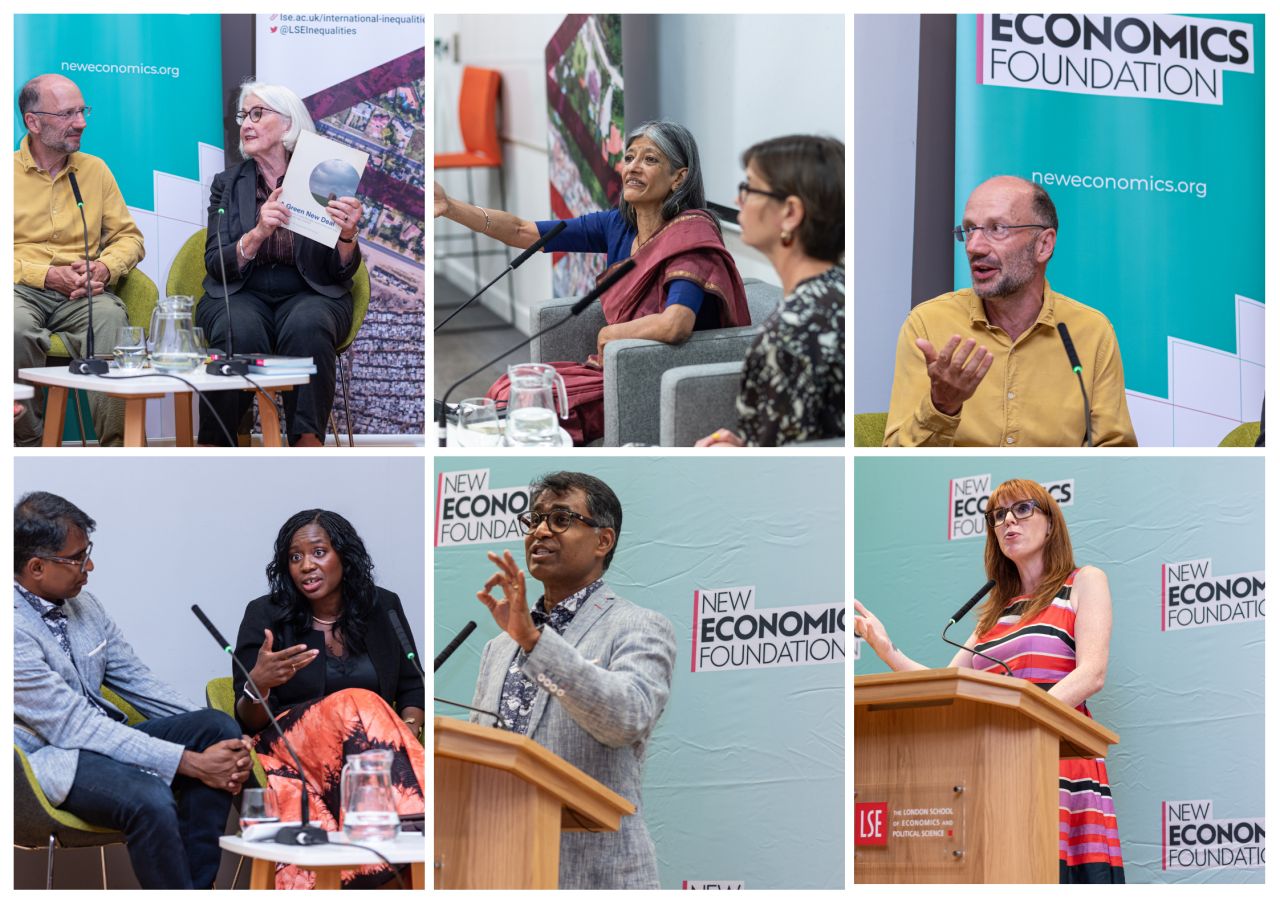
On the 1st of July, I took the train to London to attend the New Economic Foundation's 40th anniversary conference. It was billed as an opportunity to reflect on NEF's work challenging the economic orthodoxy of neoliberalism, and to look towards the future. Events like this still feel strange to me because, when I first started studying economics, I was never even aware economics had an orthodoxy.
Much of what you are taught about economics, especially in secondary school, normalises growth at any cost and celebrates inequality as an incentive for hard work. These aren't called "neoliberal ideas", they are just the ideas; they are the only way economics is done. So, whilst I have since come to learn the variety of thought in economics, thanks to some amazing professors and organisations like Rethinking Economics, it was still a shock to join the initial hundred or so attendees and hear Danny Sriskandarajah, chief executive of NEF, explain that a group of economists have been fighting against this dogma for forty years and are still going.
What followed from Danny was a genuinely fascinating history of where NEF originates. To summarise his own summary, it was the result of economists and ecologists who, as early as 1984, could see how the orthodoxy of neoliberalism was proliferating itself and that it needed to be challenged. At first, this was through "The Other Economic Summit" (named in opposition to the G7 leaders' summit hosted by Margaret Thatcher). Three years later, it developed into a fully-fledged organisation: the New Economics Foundation.
Danny then welcomed Jayati Ghosh to the stage, who delivered a keynote speech effectively bridging the gap between the critiques of economic orthodoxy that motivated NEF's founding and what she understood to be the situation we find ourselves in today. Her talk covered a lot of ground, from global inequality, to the inequality between capital and labour, to the more specific sub-category inequality between types of corporations and rentiers. Looking back through my frantically typed out notes, I'm struck by how nuanced her speech was whilst still presenting a coherent critique of what she called "rent-orientated global capital".
Her conclusion was a call for global cooperation on the limitation and redistribution of financial power, with the primary goal to reverse the inordinate rise in wealth held by increasingly few individuals. Unsurprisingly, the Q&A segment featured a lot of disagreement; challenges to Jayati's diagnosis and her solutions, issues they thought she'd missed in her analysis like gender discrimination, an obligatory UBI [Universal Basic Income] mention. I almost found it as interesting as her own speech. The audience were critiquing her critique, and it was the kind of challenging conversation I wish I could engage with more in my economics course.
We then all hurried out of the lecture theatre to catch the second half of England's World Cup match against DR Congo. The World Cup match had seemingly caused a lot of disruption to the evening's planning, rivalled by NEF's second keynote speaker dropping out a few days before the event over the small business of running for leadership of the Labour Party. All things considered, the evening went smoothly. England won 2-1 and the replacement keynote speaker was just as exciting to hear from.
Following another talk by Danny, this time focused on celebrating NEF's achievement along with the NEF alumni in attendance (an impressively large cohort, I thought!), Angela Rayner arrived to present her speech. Where Jayati's challenged the economic orthodoxy as an academic, Rayner related NEF's ideas to policy. The scope was far more domestic, on areas of policy that could have a tangible impact on people's quality of life. Obviously, in government, economic visions are tempered by political and electoral constraints, and so it was interesting to hear what the progressive economics of NEF looked like when filtered through to government policy.
The evening then concluded with a panel of NEF's senior past members and Danny himself, reflecting finally on how well they had succeeded in policy and agenda-setting. I was shocked, for the second time that evening, to hear that NEF wrote "A Green New Deal", something I had only ever heard of in relation to American politics and Alexandria Ocasio-Cortez. I had no idea that the Green New Deal was first formalised as a policy document by NEF!
I think there's a tendency for young students to believe you’re the first person to identify a problem. I certainly felt that way starting undergrad, struggling with a curriculum that was reductive and out-of-touch but was the only version of economics presented to me. All that time, there existed professional bodies of economists who had already raised these critiques; I just didn’t know they existed. I do now and it's obviously been very refreshing for me, but it's still outside of the awareness of most economics students. Most will finish their degrees never being aware of the plurality of economic thought, and some might feel so dissuaded by the unreality of mainstream economics education that they leave the discipline altogether.
I left London feeling very grateful that organisations like the New Economics Foundation exist to give space to a more grounded form of economics. It is the kind of people-focused, self-critical economics that is missing from economics education and, to me, reinforces the importance of the Association of Quality Economics in rewriting how economics is taught. With this in mind, I look forward to working further with the AQE as one of their student fellows towards ensuring that economics education adequately prepares students for the challenges of the modern world.
Louis is an Economics and Politics student at the University of Bristol, and one of the AQE's inaugural student fellows.