
When the Royal Economic Society released its 2023 report Who Studies Economics? An Analysis of Diversity in the UK Economics Pipeline, it put hard numbers to what many of us already knew: economics in the UK is not a level playing field. The discipline struggles with a “leaky pipeline,” where women, students from ethnic minority groups, and those from lower socio-economic backgrounds are more likely to leave the field at every stage, from school to undergraduate study to professional life.
One of the report’s co-authors, Professor Denise Hawkes, has been a key supporter of our work since its earliest days. Denise joined our initial roundtable at the New Economics Foundation in February, bringing her expertise and commitment to making economics more representative. Today, we are proud to have her on our advisory board, helping us shape a more inclusive accreditation framework for UK economics.
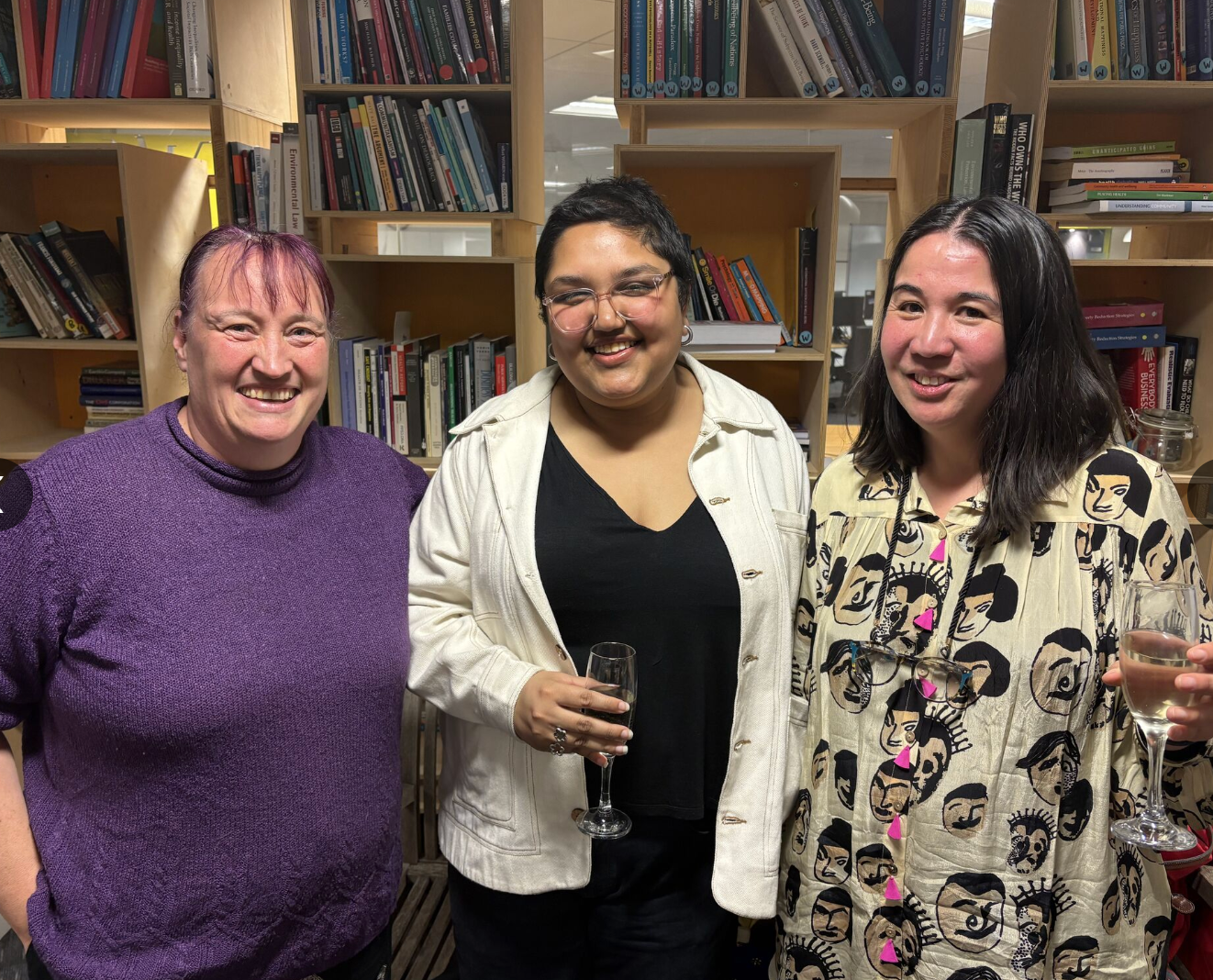
Denise Hawkes, Shloka Murarka, Susan Newman
The RES report paints a clear picture. Economics is the most elitist subject in UK higher education. Just 5% of undergraduates come from neighbourhoods with low university participation, half the rate across all subjects, while 20% were privately educated, compared with 9% overall. At Russell Group universities the imbalance is starker: only 4% of students come from low-participation areas, and nearly a third are privately educated. White male students from higher socio-economic backgrounds dominate, making up a third of undergraduates.
Gender gaps appear early. Girls are almost as likely as boys to take economics at A-level, but less likely to continue to university: 18% compared with 25%. Continuation rates show further inequality. Black, Bangladeshi, and Pakistani students are more likely to drop out after their first year, especially from lower socio-economic backgrounds. Even those who persist are less likely to achieve a “good degree” (a 2:1 or above).
There are some bright spots—women who do choose economics tend to complete and perform strongly. But overall, socio-economic background remains the decisive factor shaping who studies economics and who succeeds.
Why This Matters
The consequences of these patterns are profound. If economics continues to over-represent students from privileged backgrounds while under-representing women and minorities, the profession risks reproducing blind spots. Research and policy will be shaped by too narrow a range of perspectives. Issues like poverty, inequality, and the lived realities of marginalised groups may remain sidelined or misunderstood.
As the report notes, socio-economic background influences not only who studies economics, but also who completes their degree and with what classification. This is more than a fairness issue, it’s about the quality and credibility of economics itself. Without diversity, economics risks irrelevance.
From Evidence to Action
Our organisation was founded on the belief that we need a framework to close these gaps: to make economics degrees more inclusive, more relevant, and more trusted. We need something direct: a new membership body that represents students themselves.
A body that gives students a stronger voice could create a greater sense of connection to the subject, help build belonging, and ensure their perspectives are part of the conversation. When students feel included in this way, they are more likely to see a future for themselves in the discipline.
Bringing student perspectives forward can also enrich the curriculum. When areas like income inequality, gender economics, or racial disparities are given more attention, students may find the subject speaks more directly to their own experiences and communities. Economics can feel less distant and more relevant—not only to global debates, but to everyday life.
Change of this kind happens gradually, through ongoing dialogue between students and staff, between evidence and practice, and between universities and society. Denise Hawkes has been a thoughtful guide in helping us imagine what this might look like in practice. Her support reminds us that those who understand the evidence best also see the need for change.
This report is a wake-up call, and a roadmap. By tracking the pipeline into economics, it shows us exactly where the leaks are, and therefore where intervention matters most. Our task now is to build the mechanisms that seal those leaks and widen the field. Together, we can ensure that economics in the UK not only reflects society, but helps shape a fairer one.